
Precalculus skills to review before AP Calculus AB
Oct 28, 2026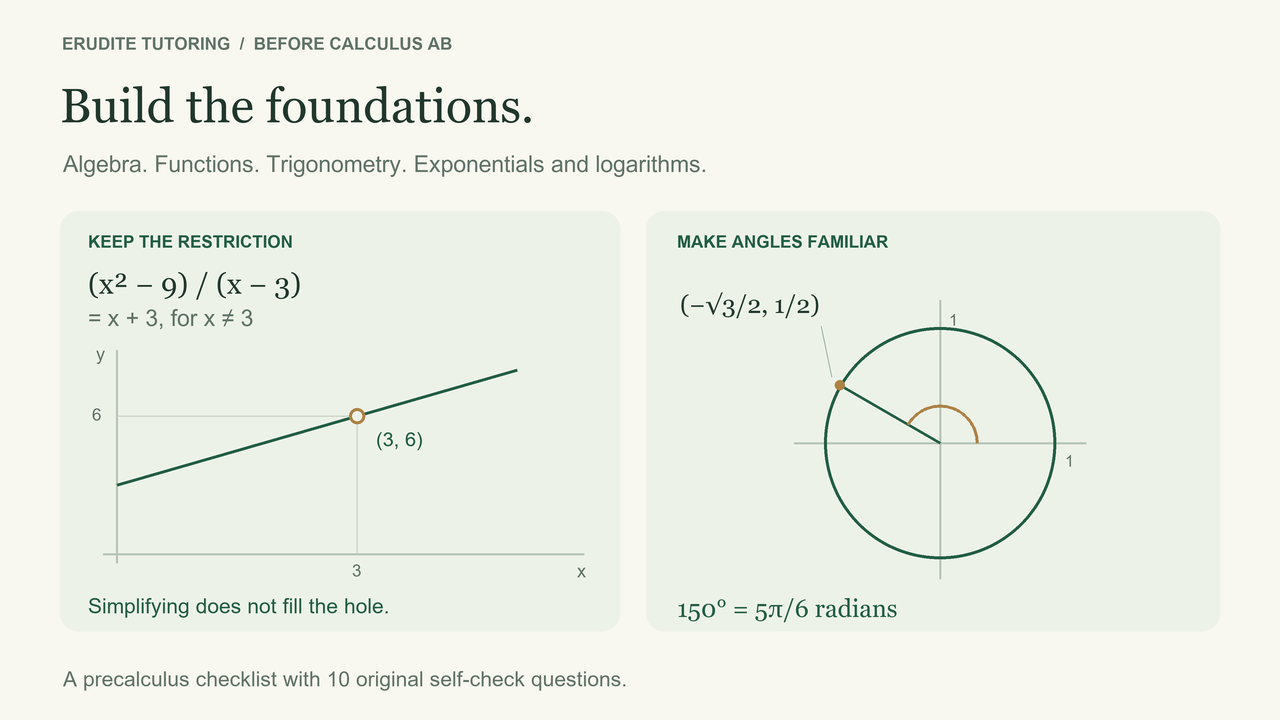
In this guide
Algebra · Functions · Radians · Trigonometry · Exponentials and logarithms · 10 self-checks
You do not need to learn calculus before starting a calculus course. You do need enough confidence with algebra, functions and trigonometry to concentrate on the new ideas. When those tools feel familiar, limits, derivatives and integrals become easier to follow.
Use this checklist to find the skills that need a short review. It is a study aid, not an admissions test or a prediction of your AP score.
1. Make algebra reliable
Practise factoring polynomials, simplifying fractions and solving equations while keeping track of restrictions. The restrictions matter just as much as the simplified expression.
(x² − 9)/(x − 3) = x + 3, for x ≠ 3.
The factor x − 3 cancels when it is nonzero. The original expression is still undefined at x = 3. That distinction will matter when you study limits: simplifying an expression does not automatically fill a hole in its domain.
2. Read functions as relationships
Know how to evaluate f(x), identify a domain, compose two functions and recognize shifts, stretches and reflections of familiar graphs. Be comfortable moving between a graph, a formula and a sentence describing a relationship.
For f(x) = √(9 − x²), the expression inside the square root must be nonnegative. Its real domain is −3 ≤ x ≤ 3. Finding that domain requires algebra, not a calculus rule.
3. Use radians comfortably
Remember the connection π radians = 180 degrees. Convert common angles without needing to look up a formula every time. For example, 150° × π/180° = 5π/6 radians.
Radians connect an angle to geometry: the angle in radians is the arc length divided by the radius. Standard calculus identities and derivative formulas for trigonometric functions use radian measure. Check your calculator mode when evaluating trigonometric expressions.
4. Know the unit circle and basic identities
Review the sine and cosine values at familiar angles, the signs in each quadrant, and the graphs of sine, cosine and tangent. Know the identity sin²t + cos²t = 1, and remember that tan t = sin t/cos t only where cos t is nonzero.
Understanding the unit circle is more useful than memorizing isolated values. At 5π/6, the reference angle is π/6 and the point is in the second quadrant, so sine is positive and cosine is negative.
5. Connect exponentials and logarithms
Think of logarithms as inverses of exponential functions. The statement ln x = 2 means x = e². For real logarithms, the input must be positive.
Review exponent rules and logarithm rules with their domain conditions. For example, ln(ab) = ln a + ln b for positive a and b. There is no corresponding rule that turns ln(a + b) into ln a + ln b.
Ten quick self-checks
Try these before reading the answers and reasoning. Write one line explaining each method. If a question feels slow, review that skill and try a similar example.
- Factor x² − x − 6.
- Simplify (x² − 9)/(x − 3), stating the restriction.
- If f(x) = √(9 − x²), find f(2) and the real domain.
- Convert 150° to radians.
- Find sin(5π/6) and cos(5π/6).
- Complete the identity: sin²t + cos²t = ____.
- Evaluate eln 7.
- Solve ln x = 2 over the real numbers.
- If f(x) = x² and g(x) = 3x − 1, find f(g(x)).
- Find the inverse of h(x) = 2x + 5.
Answers and reasoning
- (x − 3)(x + 2): the numbers multiply to −6 and add to −1.
- x + 3, with x ≠ 3. Factoring does not remove the original restriction.
- f(2) = √5. The domain is [−3, 3], since 9 − x² ≥ 0.
- 5π/6, from 150 × π/180.
- sin(5π/6) = 1/2; cos(5π/6) = −√3/2. Use the reference angle π/6 and second-quadrant signs.
- 1. This is the basic Pythagorean identity.
- 7, because the natural logarithm and exponential are inverse functions.
- x = e², which is positive and satisfies the logarithm's domain.
- (3x − 1)². Substitute the entire expression g(x) into f.
- h−1(x) = (x − 5)/2. Solve y = 2x + 5 for x, then write the inverse with x as its input.
Turn your results into a short review plan
Group uncertain questions by topic. Review one topic at a time, work a few fresh examples and explain your reasoning aloud. If your main difficulty is algebra, spend time on algebra; repeatedly watching a calculus lesson will not directly repair an algebra gap.
Keep a small error log: the problem, the step that went wrong, and the correction. Return to it after a few days. The aim is dependable skills that leave you free to think about calculus.
A structured next step
Explore Erudite's self-paced Calculus AB course overview, prerequisites and access details. View the lesson format, prerequisites, price and access details before you enroll.
Explore the course overview →The self-check questions and diagrams in this guide are original teaching examples. AP® is a trademark registered by the College Board, which is not affiliated with, and does not endorse, this website.